The Application of Technological Pedagogical and Content Knowledge (TPACK) to Student Learning Motivation and Learning Outcomes in Physical Education
Keywords:
blended learning, TPACK, learning motivationAbstract
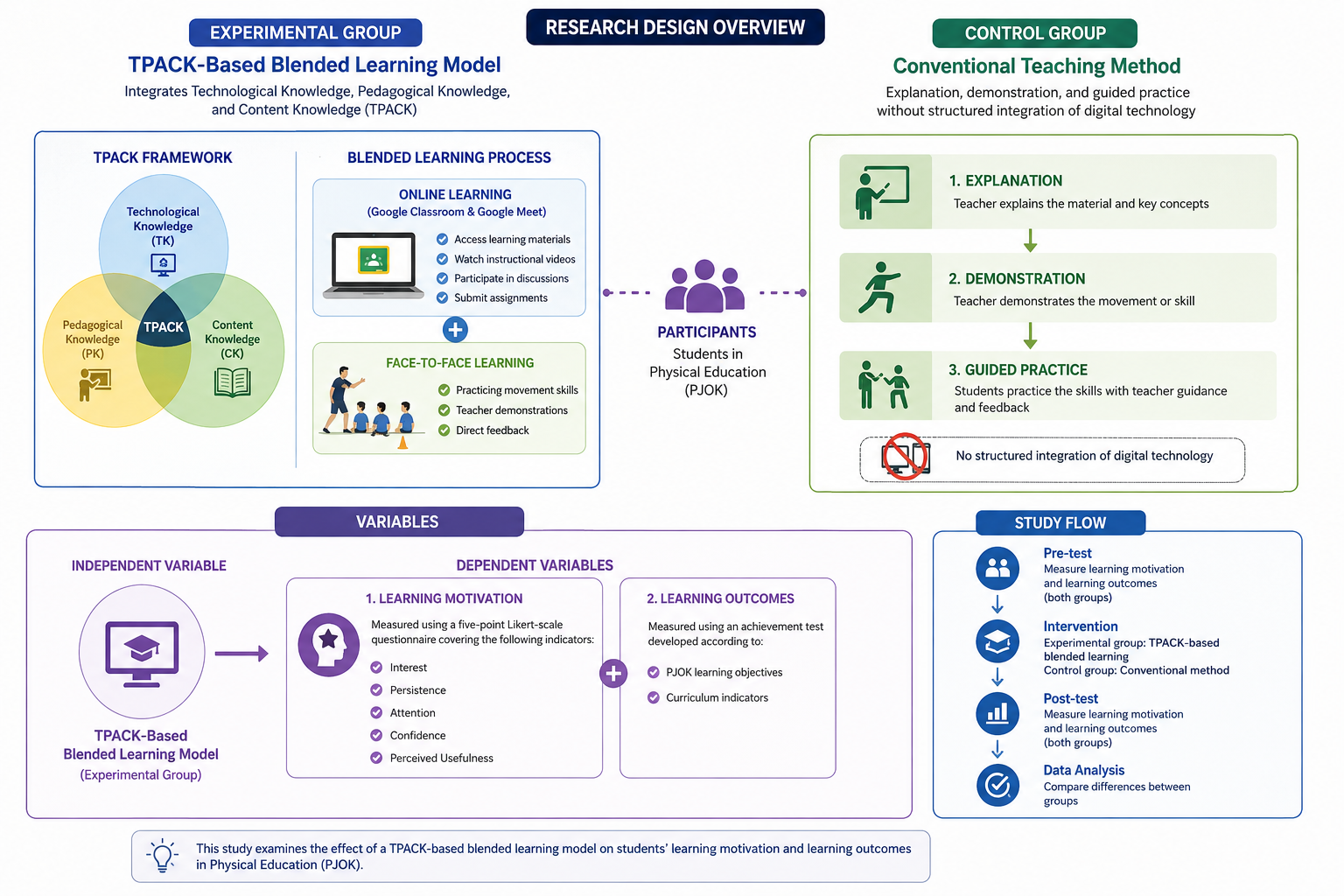
The development of digital technology supports learning innovations that have the potential to improve student motivation and learning outcomes. This study aims to examine the effect of TPACK-based blended learning implementation on Physical Education (PJOK) learning for eleventh-grade students at SMA Negeri 1 Ploso. The method used was an experiment with a control and treatment group, accompanied by a pretest and posttest. The results of the Kruskal-Wallis test showed a significance value > 0.05, but there were differences in the average values. The treatment group had higher learning motivation (52.62) than the control group (48.38), as well as slightly better learning outcomes (8.614 compared to 8.605). Thus, the implementation of TPACK-based blended learning has a positive effect on increasing student motivation and learning outcomes in PJOK learning
Downloads
References
Adam, M. T. Steffi. (2015). Pemanfaatan Media Pembelajaran Berbasis Teknologi Informasi bagi Siswa Kelas X SMA Ananda Batam. CBIS Journal, ISSN 2337- 8794.
Angeli C., V. N. (2009). Epistemological and methodological issues for the conceptualization, development, and assessment of ICT-TPCK Advances in technological pedagogical content knowledge (TPCK). Computer and Education. DOI: 10.1016/j.compedu.200.
Annisah, A. d. (2019). AudioVisual Media as an Effective Solution for Motor Learning. Jurnal Pendidikan Jasmani dan Olahraga, 04(01). DOI: 10.17509/jpjo.v4i1.12298.
Aras, Emine Y. E. (2020). e-Learning in sports education instututions in turkey. Malaysian Online Journal of Educational Sciences, EISSN-2289-3024.
Arsyad, A. (2017). Media pembelajaran. Rajawali Pers.
Beauty, T. R. (2020). Pengaruh Model Pembelajaran Permainan Sirkuit terhadap Peningkatan Kebugaran Jasmani Dan Motivasi Belajar Siswa dalam Pembelajaran PJOK. [PASCASARJANA. UNESA].
Camilleri, A. C. (2019). Mobile learning via education Apps: an interpretative study. international conference on education and training technologies. https://dl.acm.org/doi/proceedings/10.1145/3337682.
Camilleri, Adriana Caterine M. A. (2019). Mobile learning via education Apps: an interpretative study. international conference on education and training technologies. https://dl.acm.org/doi/proceedings/10.1145/3337682.
Coffey, A. M. (2014). Using Video to Develop Skills in Reflection in Teacher Education Students. Australian Journal of Teacher Education, https://search.informit.org/doi/abs/10.3316/aeipt.204406.
Cristiano, T. (2019). Google classroom as a tool-mediated for learning. Journal of Physics. DOI:10.1088/1742-6596/1161/1/012020.
Herlina, M. S. (2020). Potensi Pembelajaran Pendidikan Jasmani Olahraga Dan Kesehatan. TADULAKO JOURNAL SPORT SCIENCES AND HEALTH, ISSN 2581- 0383.
Horn, staker, H., & Michael. (2012). Classifying K–12 Blended. Innosigt Institute. Ibrahim, Sakdiah. (2017). Supervisi Akademik oleh Kepala Sekolah dalam Meningkatkan Kompetensi Profesional Guru SD Negeri 2 Calang Kabupaten Aceh Jaya. Jurnal Admistrasi Pendidikan, 5(03), ISSN 2302-0156.
Jalinus, N. V. (2020). Buku Mlodel Flipped Blended Learning. CV Sarnu Untung.
Juniarti, N., Bahari, Y., & Riva'ie, W. (2015). Faktor Penyebab Menurunnya Hasil Belajar Siswa pada Pembelajaran Sosiologi di SMA. Jurnal Pendidikan Dan Pembelajaran, 02.
Juwita, N. (2016). Perbedaan Hasil Belajar Fisika antara Siswa Atlet Binaan Dispora Provinsi Aceh dengan Siswa Nonatlet pada SMA Negeri 9 Tunas Bangsa Banda Aceh. Jurnal Ilmiah Mahasiswa (JIM) Pendidikan Fisika, 01(04), http://www.jim.unsyiah.ac.id/.
Khairuddin, Ahmad. (2019). Implementasi blended learning dalam pembelajaran PA. (http://digilib.uinsby.ac.id/36300/3/Ahmad%20Khoiruddin_%20F023170 57.pdf).
Krisnha, U. S. (2014). e-Learning Technological Development in Teaching for school kids. 05(05), ISSN:0975-9646.
Masyhudin. (2012). Keefektifan Penerapan Blended Learning Ditinjau dari Motivasi dan Hasil Belajar Siswa Kelas XI IPA SMAN 1 Kota Bima pada Materi Laju Reaksi. http://karya-ilmiah.um.ac.id/index.php/disertasi/article/view/22527.
Mishra, M. K. (2009). What is Technological Pedagogical Content Knowledge (TPACK)? CITE Journal, 09(01), ISSN 1528-5804.
Mohandas, R. (2014). Pedoman Guru Mata Pelajaran Penjasorkes untuk Guru Sekolah Menengah Atas. Pusat Kurikulum dan Perbukuan KEMENDIKBUD.
Mujiyanto. (2012). Pengaruh Model Blended Learning terhadap Pemahaman Konsep Ditinjau dari Penalaran Formal Siswa Kelas X SMA Negeri 1 Balikpapan. http://karya-ilmiah.um.ac.id/index.php/disertasi/article/view/22821.
Nasution, S. (2000). Didaktik Asas-Asas Mengajar. Bumi Aksara.
Nasution. (1994). Didaktika Azas-Azas Mengajar. Jemars.
Nurhidayat, N. (2018). Penerapan Media Pembelajaran Audio Visual untuk Meningkatkan Hasil Belajar Senam Lantai Guling Belakang. Seminar Nasional Pendidikan 2018.
Paturusi, A. (2012). Manajemen Pendidikan Jasmani dan Olahraga. Rineka Cipta. Priansa, D. J. (2019). Pengembangan Strategi dan Model Pembelajaran. Pustaka Setia. Sanjaya, W. (2014). Media Komunikasi Pembelajaran. Kencana Prenada Media Group. Semiz, K. A. (2012). Preservice Physical Education Teachers' Technological
Pedagogical Content Knowledge, Technology Integration Self-Efficacy and Instructional Technology Outcome Expectations. Australasian Journal of Educational, https://ajet.org.au/index.php/AJET/article/download/800/100.
Setiawati, O. T. (2020). Problematika Guru dalam Penilaian Afektif pada Program Studi Pendidikan Guru Sekolah Dasar. http://eprints.ums.ac.id/86063/11/NASKAH%20PUBLIKASI.pdf.
Subarjah, H. (2020). Modul Asas Pendidikan Jasmani. Academia.Edu.
Sudjana, N. (1991). Penelitian Hasil Proses Belajar Mengajar. Remaja Rosdakarya. Sukardi. (2018). Metodologi penelitian pendidikan. Bumi Aksara.
Sukmawati, N. (2019). The Role of Google Classroom in ELT. International Journal for Educational and Vocational Studies. DOI: https://doi.org/10.29103/ijevs.v1i2.1526.
Sulfemi, W. B. (2020). Model Project Based Learning Berbantu Media Kartu Dalam Pembelajaran Bahasa Indonesia Materi Kalimat Efektif Pada Surat Undangan (Project Based Learning Model Assisted With Card Media In Indonesian Language Learning Of Effective Sentences On Invitations). Metalingua. DOI: http://dx.doi.org/10.26499/metalingua.v18i2.612.
Supriyadi, M. (2018). Pelaksanaan Proses Belajar Mengajar Pendidikan Jasmani. Jurnal Gelanggang Olahraga, v1i2.136, DOI: https://doi.org/10.31539/jpjo. Utami, I. S. (2017). The Effect Of Blended Learning Model On Senior High School Students’ Achievement. SHS Web of Conferences, 42, https://doi.org/10.1051/shsconf/20184200027.
UU No. 20 Sistem Pendidikan Nasional. (2003). Diambil kembali dari https://pmpk.kemdikbud.go.id/assets/docs/UU_2003_No_20__Sistem_Pendidikan_Nasional.pdf.
Virginia, s. (2017). Keefektifan Model Pembelajaran Problem Posing Dibanding Kooperatif Tipe Circ (Cooperative Integrated Reading And Compotition) Pada Kemampuan Siswa Kelas Vii Semester 2 SMP Negeri 16 Semarang Dalam Menyelesaikan Soal Cerita Materi Pokok. Http://Lib.unnes.ac.id/1825/.
Downloads
Published
Issue
Section
Categories
License
Copyright (c) 2026 Joan Rhobi Andrianto, Arnaz Saputro (Author)

This work is licensed under a Creative Commons Attribution 4.0 International License.