Sports as a Middle Way
a Philosophical Analysis of the Concept of Taoism (Wu Wei) in Physical Education
Keywords:
Humanistic Physical Education, Taoist Philosophy, Wu WeiAbstract
Physical education in practice is still heavily influenced by a competitive and performance-oriented paradigm, which often neglects the philosophical and humanitarian dimensions of the learning process. This situation has the potential to cause physical and psychological stress for students, thus suboptimally achieving the goal of physical education as a means of developing a holistic human being. Based on these issues, this study aims to analyze the relevance of the Wu Wei principle in Taoist philosophy as an alternative philosophical foundation for physical education in a modern pedagogical context. This study uses a qualitative approach with a library research design, which examines classic Taoist texts, particularly the Tao Te Ching, as well as various academic literature discussing the philosophy of education, physical education, and contemporary sports pedagogy. Data are analyzed through content analysis and a philosophical hermeneutic approach to interpret the meaning of Wu Wei and its implications for physical education learning practices. The results of the study indicate that the dominance of the competitive paradigm in physical education is correlated with the emergence of burnout phenomena, decreased motivation, and neglected mental well-being of students. Conversely, a learning approach that emphasizes movement awareness, balance, and non-competitive activities in line with the Wu Wei principle has the potential to strengthen humanistic values, improve psychological well-being, and create a more meaningful learning experience. This study concludes that the integration of Wu Wei principles can serve as an alternative philosophical framework for developing a more humanistic, balanced physical education that is oriented toward character building and harmony between body, mind, and environment.
Downloads
References
Ames, R. (2016). Confucian Role Ethics: A Vocabulary. Honolulu: University of Hawai’i Press, 2011. 332 pp. Roger. 179–182. http://dx.doi.org/10.15446/ideasyvalores. v65n2Supl.55166
Azimov, S. (2025). The Participation Of Sport As A Socio-Cultural Phenomenon In The Formation Of Moral Qualities Of A. 3(6), 99–103.
Bowen, G. A. (2009). Document Analysis as a Qualitative Research Method. Qualitative Research Journal, 9(2), 27–40. doi:10.3316/qrj0902027
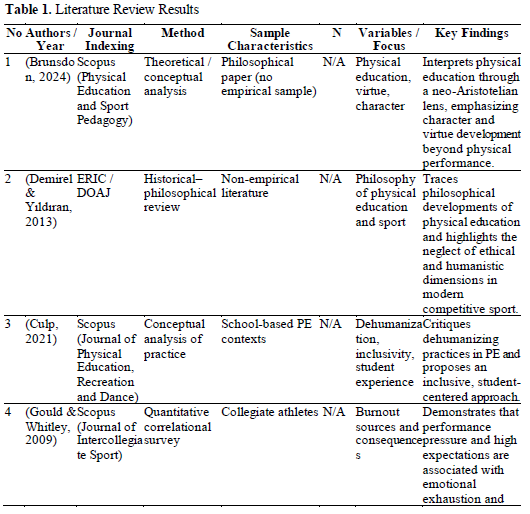
Brunsdon, J. J. (2024). Toward the virtuous mover: a neo-Aristotelian interpretation of physical education. Physical Education and Sport Pedagogy, 29(6), 588–600. https://doi.org/10.1080/17408989.2022.2135693
Capel, S., & Blair, R. (2019). Debates in Physical Education. Debates in Physical Education, 1–332. https://doi.org/10.4324/9780429504365
Creswell, J. W. (2009). Research design: qualitative, quantitative and mixed methods approachesResearch design: qualitative, quantitative and mixed methods approaches. Nurse Researcher, 12(1), 82–83. https://doi.org/10.7748/nr.12.1.82.s2
Culp, B. (2021). Everyone Matters: Eliminating Dehumanizing Practices in Physical Education. Journal of Physical Education, Recreation and Dance, 92(1), 19–26. https://doi.org/10.1080/07303084.2020.1838362
Demirel, D. H., & Yıldıran, I. (2013). The Philosophy of Physical Education and Sport from Ancient Times to the Enlightenment. European Journal of Educational Research, volume-2-2(volume2-issuse4.html), 191–202. https://doi.org/10.12973/eu-jer.2.4.191
Ennis, C. D. (2017). Educating Students for a Lifetime of Physical Activity: Enhancing Mindfulness, Motivation, and Meaning. Research Quarterly for Exercise and Sport, 88(3), 241–250. https://doi.org/10.1080/02701367.2017.1342495
Etkin, J. (2024). Embracing Holistic Physical Education: A Pedagogical Shift from Traditional Approaches. BU Journal of Graduate Studies in Education, 16(1), 5–15.
Fitrianto Ari Tri. (2023). Relevansi Pendidikan Jasmani dengan Tujuan Pendidikan Islam dalam Membentuk Individu yang Seimbang Secara Fisik, Mental, dan Spiritual. 3(2), 148–166.
Gall, M. D., Gall, J. P., & Borg, W. R. (2007). Educati on al Research : An Introduction ( 8. utg.). AE Burvikovs, Red.) USA: Pearson., 8–9. https://secure.nodebox.net/gkjfduhfy/02-yvonne-kub/9780205488490-educational-research-an-introduction-8th-edition.pdf
Gier, N. F. (2008). The Ethics of Confucius and Aristotle: Mirrors of Virtue - By Jiyuan Yu. Journal of Chinese Philosophy, 35(4), 692–695. https://doi.org/10.1111/j.1540-6253.2008.00513.x
Glandorf, H. L., Madigan, D. J., Kavanagh, O., & Mallinson-Howard, S. H. (2025). Mental and physical health outcomes of burnout in athletes: a systematic review and meta-analysis. International Review of Sport and Exercise Psychology, 18(1), 372–416. https://doi.org/10.1080/1750984X.2023.2225187
Gould, D., & Whitley, M. A. (2009). Sources and Consequences of Athletic Burnout among College Athletes. Journal of Intercollegiate Sport, 2(1), 16–30. https://doi.org/10.1123/jis.2.1.16
Jia, P., & He, X. (2024). New exploration on the philosophical examination of Chinese sportsmanship. Trans/Form/Acao, 47(5). https://doi.org/10.1590/0101-3173.2024.v47.n5.e02400156
Ken Hardman, & Green, K. (2011). Contemporary Issues in Physical Education: International Perspectives (Vol. 17).
Khanbeiki, A. (2024). The Effects of Mindfulness Training in the Physical Education on Intention to Physical Activity, Mental Health and Academic Performance among High-School Students. Physical Activity in Children, 1(1), 68–73. https://doi.org/10.61186/pach.2024.470015.1022
Kohn, L. (2006). Po Chü-i Selected Poems Daoism and Chinese Culture BY (Vol. 11, Issue 1).
Madigan, D. J., Olsson, L. F., Hill, A. P., & Curran, T. (2022). Athlete Burnout Symptoms Are Increasing: A Cross-Temporal Meta-Analysis of Average Levels from 1997 to 2019. Journal of Sport and Exercise Psychology, 44(3), 153–168. https://doi.org/10.1123/jsep.2020-0291
Marani, I. N., Muhyi, M., & Ginanjar, S. (2024). Aspek Pembelajaran Dan Metode Belajar Pendidikan Jasmani, Olahraga Dan Kesehatan. In Akademia … (Vol. 2, Issue January). https://www.researchgate.net/profile/Eka-Novita-Sari/publication/378151948_eBook_J_-_Aspek_Pembelajaran_dan_Metode_Belajar_Pendidikan_Jasmani_Olahraga_dan_Kesehatan/links/65ca97661e1ec12eff8a699d/eBook-J-Aspek-Pembelajaran-dan-Metode-Belajar-Pendidikan-Ja
Peter M. Wayne, & Fuerst, M. L. (2013). The Harvard Medical School Guide to Tai Chi. Shambhala Publications, 2013.
Ravn, S. (2022). Embodied Learning in Physical Activity: Developing Skills and Attunement to Interaction. Frontiers in Sports and Active Living, 4(January). https://doi.org/10.3389/fspor.2022.795733
Road, X., District, C., City, X., & Province, S. (2019). Research on Taoism Thought and Modern Humanistic Education Yufan Tang. 2019 9th International Conference on Education and Social Science (ICESS 2019) Research, Icess, 1638–1641. https://doi.org/10.25236/icess.2019.314
Ruaro, M. F., Santana, J. O., Gusmão, N., DE FRANÇA, E., Carvalho, B. N., Farinazo, K. B., Bonorino, S. L., Corralo, V., DE SÁ, C. A., & Caperuto, É. C. (2019). Effects of strength training with and without blood flow restriction on quality of life in elderly women. Journal of Physical Education and Sport, 19(1), 531–539. https://doi.org/10.7752/jpes.2019.01078
Slingerland, E. (2016). Effortless Actions The Chinese Spiritual Ideal of Wui-wei. January 1998.
Song, D., & Maratovch, A. K. (2023). Comparative Evaluation of Eastern and Western Physical Education Culture. Transactions on Comparative Education, 5(8), 107–113. https://doi.org/10.23977/trance.2023.050816
Tan, C. (2021). Rethinking the notion of the high-performing education system: A Daoist response. Research in Comparative and International Education, 16(1), 100–113. https://doi.org/10.1177/1745499920983694
Theroux, B. M., Chandler-Mather, N., Paynter, J., Dawe, S., & Williams, K. E. (2025). The mindful movement program in primary schools: a single-arm pilot intervention study. BMC Psychology, 13(1). https://doi.org/10.1186/s40359-025-02689-x
Thi, L., Hanh, H., Tam, L. T., & Len, N. T. (2025). Dialectical Thought – The Contemporary Relevance of Lao Tzu’s Philosophy. Journal of Posthumanism, 5(5), 1384–1394. https://doi.org/10.63332/joph.v5i5.1487
Whitehead, M. (2010). The importance of physical literacy. Physical Education Matters. 4–9.
Yudho. (2022). Filsafat Ilmu dalam Perspektif Pendidikan Jasmani dan Olahraga. 1st edn. Pangkal Pinang: Jejak Pustaka. (Issue April).
Zhu, R. (2002). Wu-Wei: Lao-zi, Zhuang-zi and the aesthetic judgement. Asian Philosophy, 12(1), 53–63. https://doi.org/10.1080/09552360220142252
Zhu, Y. (2023). Contemporary Developments in Sport Pedagogy and Their Implications for Sport Management Education. Studies in Sports Science and Physical Education, 1(2), 32–48. https://doi.org/10.56397/ssspe.2023.09.03
Downloads
Published
Issue
Section
Categories
License
Copyright (c) 2025 Aprilius Bayu, Mu’arifin Mu’arifin, Lalu Moh Yudha Isnaini (Author)

This work is licensed under a Creative Commons Attribution 4.0 International License.