Analysis of the Effect of Core Stability on the Risk of Lower Extremity Injuries in Futsal Players
A Literature Review
Keywords:
core stability, futsal, lower extremity injury, biomechanics, injury riskAbstract
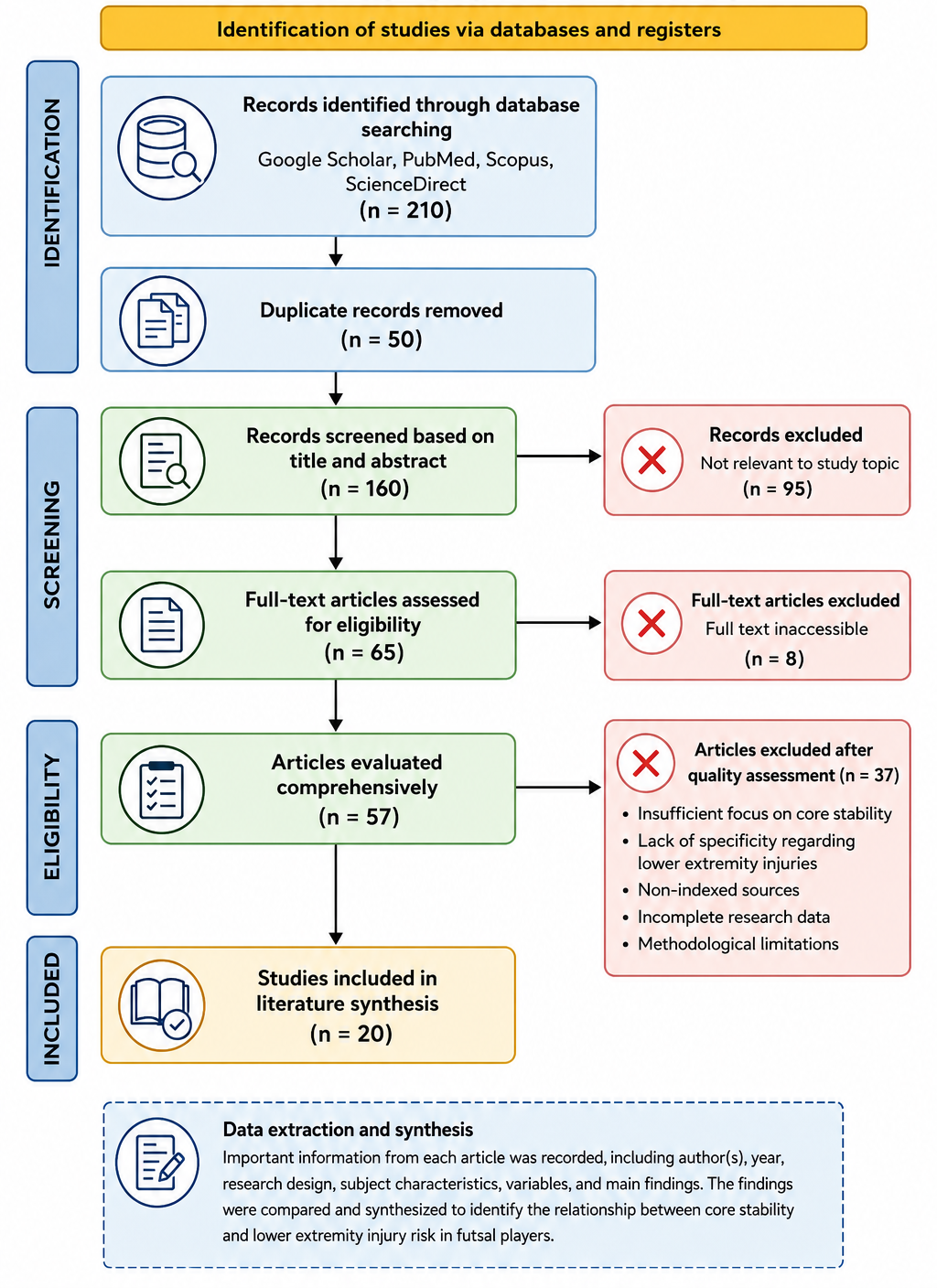
Futsal Futsal is a high-intensity sport characterized by rapid acceleration, deceleration, sudden changes of direction, jumping, and repetitive physical contact. These demanding movement patterns place considerable mechanical stress on the musculoskeletal system, particularly the lower extremities, making futsal players highly susceptible to injuries such as ankle sprains, knee injuries, hamstring strains, and anterior cruciate ligament (ACL) tears. Among the intrinsic factors associated with injury prevention, core stability has emerged as a critical component in maintaining spinal stability, pelvic control, and efficient body movement coordination during dynamic activities. This literature review aims to analyze the effect of core stability on the risk of lower extremity injuries in futsal players. The study employed a literature review approach by examining national and international scientific articles published between 2015 and 2026, retrieved from databases including Google Scholar, PubMed, and Scopus. The findings indicate that poor core stability is associated with impaired dynamic balance, decreased neuromuscular control, increased knee valgus, and ankle instability, all of which contribute to a greater risk of lower extremity injuries. Conversely, improved core stability has been shown to enhance movement biomechanics, optimize force distribution, and improve movement efficiency during sports performance. Therefore, core stability training should be integrated into futsal training and injury prevention programs to enhance athletic performance while reducing the incidence of lower extremity injuries futsal.
Downloads
References
Asurmendi, Í., Oficialdegui, M., & Marín, P. J. (2025). Gender-Specific Relationships Between Ankle Mobility, Foot Strength, and Trunk Control in Futsal Players: A Cross- Sectional Study. Journal of Musculoskeletal & Neuronal Interactions, 25(3), 258.
De Blaiser, C., Roosen, P., Willems, T., Danneels, L., Vanden Bossche, L., & De Ridder, R. (2018). Is core stability a risk factor for lower extremity injuries in an athletic population? A systematic review. Physical Therapy in Sport, 30, 48–56.
De Blaiser, C., Roosen, P., Willems, T., De Bleecker, C., Vermeulen, S., Danneels, L., & De Ridder, R. (2021). The role of core stability in the development of non-contact acute lower extremity injuries in an athletic population: A prospective study. Physical Therapy in Sport, 47, 165–172.
Gene-Morales, J., Saez-Berlanga, A., Bermudez, M., Flández, J., Fritz, N., & Colado, J. C. (2021). Incidence and prevalence of injuries in futsal: A systematic review of the literature. Journal of Human Sport & Exercise, 16.
Gulrandhe, P., & KOVELA, R. K. (2023). The Effect of Dynamic Neuromuscular Stabilisation on Core Strength: A Literature Review. Journal of Clinical & Diagnostic Research, 17(7).
Howell, D. R., Lynall, R. C., Buckley, T. A., & Herman, D. C. (2018). Neuromuscular control deficits and the risk of subsequent injury after a concussion: a scoping review. Sports Medicine, 48(5), 1097–1115.
Islam, M. S., Al Mamun, M., & Hoque, I. (2025). A guide to literature reviews: a comprehensive flowchart beyond PRISMA for sample selection and justifications. Management Review Quarterly, 1–18.
Kim, H., Sefcik, J. S., & Bradway, C. (2017). Characteristics of qualitative descriptive studies: A systematic review. Research in Nursing & Health, 40(1), 23–42.
Logerstedt, D. S., Ebert, J. R., MacLeod, T. D., Heiderscheit, B. C., Gabbett, T. J., & Eckenrode, B. J. (2022). Effects of and response to mechanical loading on the knee.Sports Medicine, 52(2), 201–235.
Malanga, G. A., Aydin, S. M., Holder, E. K., & Petrin, Z. (2016). Functional therapeutic and core strengthening. In The hip and pelvis in sports medicine and primary care (pp. 185–214). Springer.
Mandorino, M., Figueiredo, A. J., Gjaka, M., & Tessitore, A. (2023). Injury incidence and risk factors in youth soccer players: a systematic literature review. Part II: Intrinsic and extrinsic risk factors. Biology of Sport, 40(1), 27–49.
Oudh, R. H. (2025). The Effect of Motor Balance Training on Certain Physical Variables and Skill Performance of Junior Futsal Players. Musamus Journal of Physical Education and Sport (MJPES), 7(4), 156–168.
Pati, D., & Lorusso, L. N. (2018). How to write a systematic review of the literature. HERD: Health Environments Research & Design Journal, 11(1), 15–30.
Pontillo, M., Butowicz, C. M., Ebaugh, D., Thigpen, C. A., Sennett, B., & Silfies, S. P. (2020). Comparison of core neuromuscular control and lower extremity postural stability in athletes with and without shoulder injuries. Clinical Biomechanics, 71, 196–200.
Prieske, O., Muehlbauer, T., & Granacher, U. (2016). The role of trunk muscle strength for physical fitness and athletic performance in trained individuals: a systematic review and meta-analysis. Sports Medicine, 46(3), 401–419.
Rodríguez, S., Hernández-Álvarez, E. D., & León-Prieto, C. (2025). The Impact Of Core Stability Training On Balance Performance In Soccer Players: Systematic Review And Meta-Analysis. Football Studies, 100009.
Willardson, J. M. (2024). Core anatomy and biomechanics. Developing the Core,
Zemková, E., & Zapletalová, L. (2022). The role of neuromuscular control of postural and core stability in functional movement and athlete performance. Frontiers in Physiology, 13, 796097.
Downloads
Published
Issue
Section
Categories
License
Copyright (c) 2026 Fachrun Nisa Sofiyah Khasanah, Itsna Rosyada (Author)

This work is licensed under a Creative Commons Attribution 4.0 International License.