Fitness Centers and Gyms from a Physical Education Perspective
A Literature Review on Their Concepts, Functions, and Contributions to Improving Public Health and Fitness
Keywords:
active lifestyle, fitness center, gyms, physical activity, physical education, physical health, physical literacy, public fitnessAbstract
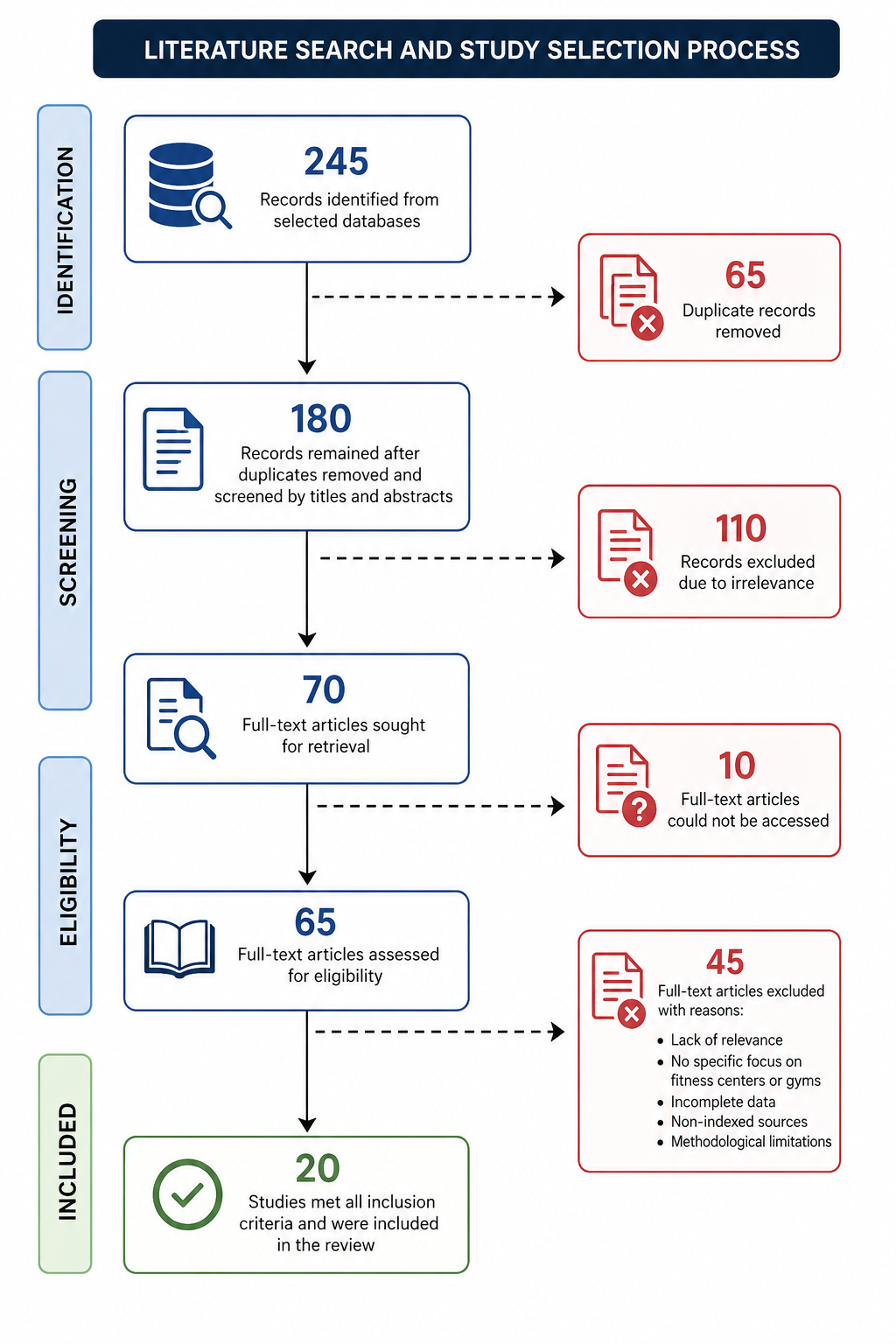
This study addresses the growing paradox between the well-established benefits of physical activity and the persistent global prevalence of physical inactivity by examining the role of fitness centers and gyms from a physical education perspective. While these facilities are commonly viewed as spaces for exercise, their broader educational, behavioral, and public health contributions remain underexplored. Therefore, this study aims to analyze the concepts, functions, and contributions of fitness centers and gyms in promoting physical literacy and sustainable active lifestyles. A systematic literature review (SLR) was conducted following PRISMA 2020 guidelines, using data from Scopus, Web of Science, PubMed, and Google Scholar. A total of 245 records were identified, of which 20 studies met the inclusion criteria after screening and eligibility assessment. The findings indicate that fitness centers and gyms contribute significantly to improving physical fitness, metabolic health, and psychological well-being. Beyond physiological outcomes, these facilities also play an important role in shaping motivation, self-efficacy, and long-term engagement in physical activity. Additionally, factors such as accessibility, inclusivity, and socioecological influences were found to affect participation. The review further reveals that fitness environments can function as informal learning spaces that support the development of physical literacy, although this role remains underemphasized in existing research. In conclusion, fitness centers and gyms have substantial potential as strategic platforms for promoting public health and active lifestyles. A more integrative approach that combines physical, educational, and behavioral dimensions is needed to optimize their contribution within the broader context of physical education and public health.
Downloads
References
Arena, R., Myers, J., Kaminsky, L. A., Williams, M., Sabbahi, A., Popovic, D., Olivares, S. L. O. (2021). Current activities centered on healthy living and recommendations for the future: a position statement from the HL-PIVOT network. Current Problems in Cardiology, 46(6), 100823.
Avci, A. B., Balci, G. A., & Basaran, T. (2024). Exercise and resting periods: Thermal comfort dynamics in gym environments. In Building Simulation (Vol. 17, pp. 1557–1578). Springer.
Biddle, S. J. H., Ciaccioni, S., Thomas, G., & Vergeer, I. (2019). Physical activity and mental health in children and adolescents: An updated review of reviews and an analysis of causality. Psychology of Sport and Exercise, 42, 146–155.
Celli, A., Barnouin, Y., Jiang, B., Blevins, D., Colleluori, G., Mediwala, S., … Villareal, D. T. (2022). Lifestyle intervention strategy to treat diabetes in older adults: a randomized controlled trial. Diabetes Care, 45(9), 1943–1952.
Chen, M., Li, Q., & Wang, L. (2024). Understanding factors influencing people with disabilities’ participation in sports and cultural activities. BMC Public Health, 24(1), 389.
Cunningham, C., O’Donoghue, G., Cosgrave, S., Sands, T., Leacy, B., Markievicz, I., … Shields, N. (2023). Gym staff perspectives on disability inclusion: A qualitative study. Disability and Rehabilitation, 45(3), 441–448.
dos Santos Duarte Junior, M. A., López-Gil, J. F., Caporal, G. C., & Mello, J. B. (2022). Benefits, risks and possibilities of strength training in school Physical Education: a brief review. Sport Sciences for Health, 18(1), 11–20.
Duarte-Anselmi, G., Crane, S. M., Ruiz, M. A., & Dintrans, P. V. (2025). Behavioral science meets public health: a scoping review of the fogg behavior model in behavior change interventions. BMC Public Health, 25(1), 3468.
Ekelund, U., Tarp, J., Fagerland, M. W., Johannessen, J. S., Hansen, B. H., Jefferis, B. J., … Howard, V. J. (2020). Joint associations of accelerometer-measured physical activity and sedentary time with all-cause mortality: a harmonised meta-analysis in more than 44 000 middle-aged and older individuals. British Journal of Sports Medicine, 54(24), 1499–1506.
Fahdan, N. A., & Pratama, R. S. (2025). Strategi Meningkatkan Partisipasi Anak dalam Kegiatan Olahraga di PAUD. Khirani: Jurnal Pendidikan Anak Usia Dini, 3(1), 1–15.
Farmer, H., Xu, H., & Dupre, M. E. (2022). Self-efficacy. In Encyclopedia of gerontology and population aging (pp. 4410–4413). Springer.
Irawan, I. W. P. (2025). Hubungan Literasi Fisik dengan Motivasi Mengikuti Aktivitas Olahraga Pada Mahasiswa Jurusan Pendidikan Jasmani. Jurnal Riset Multidisiplin Edukasi, 2(12), 1322–1330.
Jansson, A. K., Lubans, D. R., Duncan, M. J., Smith, J. J., Plotnikoff, M., Robards, S. L., & Plotnikoff, R. C. (2022). Descriptive epidemiology of outdoor gym use in an Australian regional setting. Journal of Public Health, 30(1), 159–165.
Kandola, A., Lewis, G., Osborn, D. P. J., Stubbs, B., & Hayes, J. F. (2020). Depressive symptoms and objectively measured physical activity and sedentary behaviour throughout adolescence: a prospective cohort study. The Lancet Psychiatry, 7(3), 262–271.
Kelly, J. A. (2024). Strategies for member retention in boutique fitness clubs. Walden University.
Lange, S., Bolt, G., Vos, S., & Völker, B. (2025). Inclusion of the marginalized: The case of sport participation: A scoping review. Journal of Global Sport Management, 10(3), 431–463.
Lee, H. K., & Jin, J. (2024). Combined virtual-reality-and gym-based physical activity intervention for children with a developmental disability: Effects on physical activity levels, motor skills, and social skills. Adapted Physical Activity Quarterly, 41(4), 513–533.
Leslie, E., Luna, V., & Gibson, A. L. (2023). Older adult aerobic capacity, muscular strength, fitness and body composition after 20+ years of exercise training: a systematic review and meta-analysis. International Journal of Exercise Science, 16(3), 620.
Lyons, G., Mokhtarian, P., Dijst, M., & Böcker, L. (2018). The dynamics of urban metabolism in the face of digitalization and changing lifestyles: Understanding and influencing our cities. Resources, Conservation and Recycling, 132, 246–257.
Marquez, D. X., Aguiñaga, S., Vásquez, P. M., Conroy, D. E., Erickson, K. I., Hillman, C., … Petruzzello, S. J. (2020). A systematic review of physical activity and quality of life and well-being. Translational Behavioral Medicine, 10(5), 1098–1109.
Mitchell, F. R., Horton, S., Scharoun Benson, S., Mogyorody, V., & van Wyk, P. M. (2026). Comparing performance and experience in a conventional and accessible gym: a mixed methods study. Disability and Rehabilitation, 48(3), 756–778.
Monadi, A., Behzadfar, M., Nikabadi, S., & Farazjou, F. (2025). Impact of Facility Accessibility and Program Availability on Sport Participation Rates Across Socioeconomic Groups. Journal of Social Studies, 11(5), 156–163.
Nathan, R. J., Tan, P.-K., & Victor, V. (2022). Fitness trainers’ physical attractiveness and gym goers’ exercise intention. International Journal of Business and Society, 23(1), 496–517.
Oppert, J.-M., Ciangura, C., & Bellicha, A. (2023). Physical activity and exercise for weight loss and maintenance in people living with obesity. Reviews in Endocrine and Metabolic Disorders, 24(5), 937–949.
Paschalidou, K., Tsitskari, E., Alexandris, K., Karagiorgos, T., & Filippou, D. (2023). Segmenting fitness center customers: Leveraging perceived ethicality for enhanced loyalty, trust, and word-of-mouth communication. Sustainability, 15(22), 16131.
Plotnikoff, R. C., Jansson, A. K., Duncan, M. J., Smith, J. J., Bauman, A., Attia, J., & Lubans, D. R. (2023). mHealth to support outdoor gym resistance training: the ecofit effectiveness RCT. American Journal of Preventive Medicine, 64(6), 853–864.
Ramos-Campo, D. J., Andreu Caravaca, L., Martinez-Rodriguez, A., & Rubio-Arias, J. Á. (2021). Effects of resistance circuit-based training on body composition, strength and cardiorespiratory fitness: a systematic review and meta-analysis. Biology, 10(5), 377.
Riseth, L., Lund Nilsen, T. I., Hatlen Nøst, T., & Steinsbekk, A. (2022). Fitness center use and subsequent achievement of exercise goals. A prospective study on long-term fitness center members. BMC Sports Science, Medicine and Rehabilitation, 14(1), 9.
Sharma, R. (2023). Promoting social inclusion through social policies. Capacity Building and Youth Empowerment, 76, 617.
Soekmawati, Nathan, R. J., Victor, V., & Pei Kian, T. (2022). Gym-Goers’ Self-Identification with Physically Attractive Fitness Trainers and Intention to Exercise. Behavioral Sciences (Basel, Switzerland), 12(5). https://doi.org/10.3390/bs12050158
Terauchi, Y., Takada, T., & Yoshida, S. (2022). A randomized controlled trial of a structured program combining aerobic and resistance exercise for adults with type 2 diabetes in Japan. Diabetology International, 13(1), 75–84.
Tokarski, W., Tosounidis, A., & Zarotis, G. F. (2023). The need for health and prevention through fitness sports. European Journal of Sport Sciences, 2(4), 34–42.
Tross, L. F. S., Magalhães Dias, H., & Callegari Zanetti, M. (2024). Maintaining exercise in fitness centre settings: insights from the physical activity maintenance theory. International Journal of Qualitative Studies on Health and Well-Being, 19(1), 2409832.
Van Pelt, K. L., Puetz, T., Swallow, J., Lapointe, A. P., & Broglio, S. P. (2021). Data-driven risk classification of concussion rates: a systematic review and meta-analysis. Sports Medicine, 51(6), 1227–1244.
Vella, S. A., Aidman, E., Teychenne, M., Smith, J. J., Swann, C., Rosenbaum, S., … Lubans, D. R. (2023). Optimising the effects of physical activity on mental health and wellbeing: A joint consensus statement from Sports Medicine Australia and the Australian Psychological Society. Journal of Science and Medicine in Sport, 26(2), 132–139.
Wanasari, S. M., Noordia, A., Yuliastrid, D., & Kumaat, N. A. (2024). Motivasi member gym dan tingkat perubahan perilaku sehat ditinjau dari perbedaan jenis kelamin. Bravo’s: Journal of Physical Education and Sport Science, 12(1), 79–88.
Wang, X., Zhou, Q., Zhang, M., & Zhang, Q. (2021). Exercise in the park or gym? The physiological and mental responses of obese people walking in different settings at different speeds: a parallel group randomized trial. Frontiers in Psychology, 12, 728826.
Wargama, I. M. D. S. (2025). Analisis Pola Pemanfaatan Fitness Center dalam Meningkatkan Kesehatan dan Kebugaran Masyarakat. Athena: Physical Education and Sports Journal, 3(2), 64–71.
Wargama, I. M. D. S. (2026). Fitness Center Sebagai Ruang Sosial Baru: Kajian Sosial-Ekonomi Perilaku Aktivitas Fisik Masyarakat. Jurnal Ilmiah Spirit, 26(1), 330–340.
Wargama, I. M. D. S., Rahayu, T., Priyono, B., Mukarromah, S. B., Pramono, H., Setyawati, H., … Suryadi, D. (2024). ¿ Cuál es la relación entre socioeconomía y actividad física? Revisión bibliográfica (What is the relationship between socioeconomics and physical activity? Literature review). Retos, 61, 148.
Wargama, I. M. D. S., Soegiyanto, S., & Hadi, H. (2022). Semarang Citizens’ Culture And Psychosocial Behavior In Physical Activity At The Fitness Center. JUARA: Jurnal Olahraga, 7(1), 90–103.
Wargama, S. (2025). Fitness Center Sebagai Katalisator Perubahan Perilaku Hidup Sehat dan Bugar: Studi Kualitatif di Kabupaten Tanah Bumbu. Jurnal Pemuda Indonesia, 2(1).
Yu, G., & Song, Y. (2022). What affects sports participation and life satisfaction among urban residents? The role of self-efficacy and motivation. Frontiers in Psychology, 13, 884953.
Zhou, C., Bairner, A., & Molnár, G. (2026). From the school gym to adulthood: gendered pathways of physical education and post-divorce physical activity in China. Sport, Education and Society, 1–16.
Downloads
Published
Issue
Section
Categories
License
Copyright (c) 2026 I Made Dwi Sastra Wargama, Amin Brilian Wicaksono Gussanto, Titis Pambudi, Wayan Kristin (Author)

This work is licensed under a Creative Commons Attribution 4.0 International License.